
Mapping of structural discontinuities in the Otago Schist as potential exploration targets: preliminary results
Alteration
and Mineralisation in the Busang Gold Prospect,
Terry
M. Leach
East,
Abstract
Core samples, which were collected by
the author from the Busang prospect,
progressive evolution of a large magmatic-related hydrothermal system that is
comparable to that encountered in many similar systems elsewhere in the Pacific
region. The initial, localized deposition of sheeted porphyry quartz-molybdenite veins took place at high temperatures and fluid
salinities, and at relatively deep levels. This was followed by an extensive
phase of phyllic (sericite-quartz-pyrite ± tourmaline-apatite) wallrock replacement and vein formation.
Propylitic (epidote-chlorite-carbonate-quartz) alteration was formed marginal
to the phyllic assemblages. These porphyry-related events were centred in the
Southeast Zone, and are probably associated with the emplacement of a felsic intrusion at depth. This event
contributed only trace gold to the system.
The early stages of hydrothermal
activity were followed by an episode of quartz (± adularia) carbonate base metal sulphide veining, which was
accompanied by argillic (illitic-kaolin clay) wallrock alteration. This event
was sulphide-rich in the Central Zone and carbonate-dominated in the Southeast
Zone. Gold mineralisation was observed in Central Zone drillcore to be
associated with both sulphide, as well as carbonate, deposition. A final stage
of epithermal-style quartz ± stibnite realgar veins are, in the
Central Zone, locally gold-bearing. The latter two events are interpreted to be
associated with the late-stage exsolution of
metal-bearing brines from the felsic intrusion that
formed the earlier porphyry quartz-molybdenite veins
and widespread phyllic-propylitic alteration..
Introduction
This paper is a summary of the results of
a petrological study that was carried out on a suite
of one hundred and twenty-nine core samples that were collected by the author
while on site at the Busang Prospect,
1997.
Samples were selected mainly from 10cm
long skeleton core that was stored on site, although whole core samples were
also collected from three holes that had not yet been sampled for assaying. A
suite of forty-seven samples was collected from twenty-three holes that were
drilled in the Central Zone, and fifty-three samples were selected from six
holes in the Southeast Zone. The remaining twenty-nine samples were selected
from Drillhole BDH 5, which was a 980m deep hole
drilled under the Southeast Zone.
There has been a considerable amount of
factually incorrect information made available over the last five years on the
geological characteristics of the Busang prospect
area. It is hoped that this paper will present a sound scientific approach that
may help to balance out this lack of basic data.
Structural Setting
The Busang
prospect is located in
localised at the intersection of the NE-trending
NW-striking transfer structures. A similar tectonic setting hosts gold
mineralisation at the Kelian gold mine approximately
150km to the southwest of Busang, at the
A 1km x 500m wide zone of alteration in
the Central Zone (CZ) at Busang is thought to have
been the focus of dilation of pre-existing EW fractures by dextral movement on
the transfer structures. NW-trending
alteration in the Southeast Zone (SEZ) extends over a strike length of more
than 3km and is postulated also to be related to movement on these transfer
structures.
Geological Setting
Alteration and mineralisation at Busang are hosted in a series of polyphasal porphyry
intrusions that are dominantly dacite in composition in the Central Zone, and andesite in the Southeast Zone. These porphyry bodies have
been emplaced into a sequence of intercalated carbonaceous sandstones and
siltstones. Late stage flow banded feldspar porphyry dykes cut the dacite/andesite porphyry intrusions and result in visually sharp
alteration contrasts where they cut previously altered hostrocks.
Diorite porphyry intrusions have been
intersected at depth beneath the Southeast Zone and are inferred to be the
deeper equivalents of the shallower level andesite
porphyry bodies.
Basic sub-volcanic dykes crosscut the andesite / dacite intrusions and range from basaltic andesite to basalt in composition. Some of the basic dykes
are pre-mineral, whereas others are post-mineral. Late, but pre-mineral, rhyolite dykes have been previously recorded, but were not
observed in the cores analysed during this study.
Intrusion, hydromagmatic,
fluidised and vein/dilational breccias are common in the core collected for
this study. Diatreme-like breccias were observed in
outcrop during the site field work.
Very similar lithologies
and breccias are host to mineralisation in the Kelian
gold deposit (van Leeuwen et al., 1990).
Sequence of Hydrothermal Events
Three main stages of hydrothermal
alteration (replacement and deposition) have been recognised at Busang (Figure 1). It postulated that these events are
associated with the same overall hydrothermal system that evolved with time.
Stage I : Porphyry Event
This stage of hydrothermal activity is
characterized by an initial phase of porphyry-style quartz vein development,
followed by an episode of phyllic and propylitic alteration and veining. These
porphyry-related assemblages are most extensively developed in the drillcore
from the Southeast Zone
In the deep drillhole
BDH 5, centimetre-wide, sheeted to conjugate fracture sets host porphyry quartz
± anhydrite veins at depths of 500-700m beneath the central part of
the Southeast Zone. These veins are
characteristically grey due to the presence of abundant primary and secondary
liquid- and vapour-rich inclusions.
Halite daughter crystals are present in
some of the liquid-rich inclusions and these are indicative of periods when the
fluids were hypersaline (>25 wt% equivalent NaCl). The deposition of the porphyry-related quartz veins
was polyphasal, and locally extended to very shallow levels.
Anhydrite occurs as intergrowths with,
and inclusions in some of the porphyry quartz veins, although in most cases
anhydrite deposition post-dates the quartz.
Extensive zones of porphyry-related,
propylitic and intense phyllic alteration occur over an area in excess of 700m x 3.5km and
to depths of more than 400m in the
Southeast Zone, and are aligned along the NE-trending transfer structural zone.
The phyllic assemblage is dominated by
coarse-grained 2M sericite (and locally muscovite) + quartz + pyrite. A purple
anhydrite locally overgrows porphyry quartz in veins and is in turn overgrown
by sericite. Dark blue-green tourmaline (schrol) is
commonly associated with the quartz-sericite-pyrite wallrock alteration and
overgrows sericite in veins. It is also associated with later dolomite-calcite
deposition. Apatite occurs as minute grains with the phyllic alteration
assemblage and commonly replaces wallrock mafic phenocrysts. .
The propylitic alteration / veining is characterized by the presence of epidote + quartz +
chlorite + carbonate ± sericite and is peripheral to the
phyllic alteration zones.
Fine grained milled matrix (fluidized)
breccias locally cross-cut the porphyry-related quartz veins and are a
pre-cursor to the later carbonate-base metal system. In places these breccias
contain clasts of earlier quartz vein material. The clasts are sealed in a
comminuted matrix that is altered to illitic clay and/or sericite ± quartz carbonate pyrite. It is speculated that these breccias
may be related to the phreatomagmatic (diatreme) breccias observed at the surface. A compilation
of field mapping and drill core logging is necessary in order to fully evaluate
the presence of a diatreme-maar complex at Busang, and this lies outside the scope of this study.
Stage II : Carbonate Base
Metal ±
Gold Event
Sheeted carbonate base metal veins
occur in the Central Zone to the north of the porphyry system, and are inferred
to be genetically related to the dextral rotation on the NE-trending accretionary structures. In outcrop, it was observed that
the carbonate-base metal sulphide assemblages were also deposited along the
fractured and brecciated contacts between the high level dacite intrusions and
host sediments
Early quartz ± adularia lines the veins and is overgrown by pyrite, arsenopyrite,
sphalerite, galena and rare tennantite. Carbonates
are intergrown with, but mainly overgrow, the sulphide minerals and infill
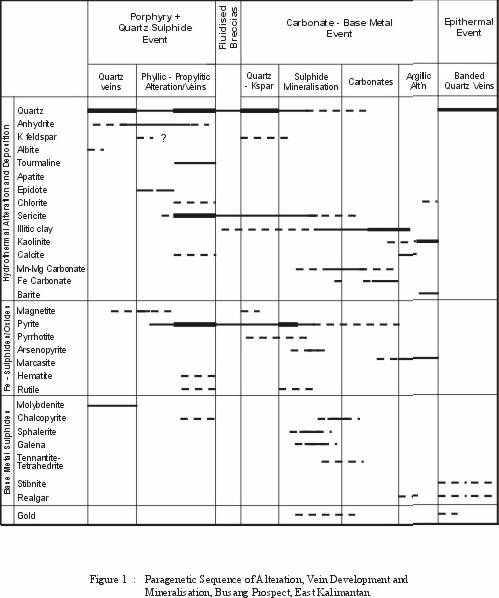
the veins. This sequence of deposition is comparable to that described
from many similar carbonate-base metal gold systems in the Southwest Pacific
region (Corbett and Leach, 1998).
The carbonate base metal event extends
into the Southeast Zone where it is present as base-metal-poor,
carbonate-pyrite marcasite stockwork veinlets and crackle breccia zones, and
as rare discontinuous, sulphide-rich psuedo-veins.
At depth in the SEZ, the carbonate-base metal veins cut both the quartz-molybdenite and massive pyrite veins.
Quartz-sericite/illite alteration accompanies the sheeted carbonate base metal
veins in the Central Zone; whereas widespread, lower temperature, intense
argillic alteration (kaolin illitic clays) is associated with the
carbonate-rich veins in the Southeast Zone where it has overprinted the earlier
porphyry-related phyllic assemblages.
As in other carbonate-base metal systems,
a wide variety of carbonate species are present. These range from early mixed Mn-Mg-Fe-Ca carbonates (kutnahorite,
ankerite), followed by Fe-rich carbonates (siderite,
Fe-dolomite) and late stage, clear calcite. Mixed carbonates are commonly
associated with higher temperature sericite-quartz wallrock alteration and vein
deposition; whereas later Fe-carbonates are associated with kaolinite and lower
temperature illite assemblages.
The carbonate minerals are overall more Mn-rich in veins in the Southeast Zone, and more Mg-rich in
veins in the Central zone. Abundant manganese oxide in outcrop in the Southeast
zone attests to the abundance of the Mn-carbonate
veins.
Trace barite locally fills open spaces in
the carbonate-base metal veins.
This is the main gold mineralisation
event at Busang.
Stage III : Epithermal Quartz Veins
Rare quartz-rich, locally crustiform
banded veins occur in the Central Zone drillcore. These are accompanied by
stibnite and realgar-orpiment mineralisation. These late stage epithermal
quartz veins appear to post-date the carbonate-base metal event.
Stage IV :
Weathering / Supergene
The samples collected for this study were
selected in order to evaluate the primary or hypogene
characteristics of the alteration and mineralisation and therefore attempted to
exclude the supergene effects of weathering. However, it was noted that the
oxidation, by groundwaters, of sulphide minerals in
fractures and veins in places extended to depths of greater than 150m.
Fluid Inclusions
Fluid inclusion heating and freezing
analyses were carried out on quartz from Stage I porphyry veins and on quartz
and carbonate from Stage II veins in samples from the Central Zone.
Both liquid- and vapour-rich inclusions
were observed in the quartz form the porphyry veins indicative of two-phase
(boiling) conditions during deposition. The liquid-rich inclusions homogenized
at 260-446°C and freezing analyses indicated saline conditions (4-15 wt%
equivalent NaCl). Some of the liquid-rich inclusions
contain halite daughter crystals suggesting periodic hypersaline
(>25 wt% equivalent NaCl) fluid conditions.
High temperature and salinity conditions
during quartz deposition, the association with molybdenite
mineralisation and the sharp contacts of the sheeted veins are characteristic
of B-type porphyry veins. Quartz, deposited during the early stages of the
Stage II carbonate-base metal veins, contains only liquid-rich fluid inclusions
and was deposited over a temperature range of 230-311°C (average of sixty-five measurements = 262 °C ) from a relatively dilute (1.7-2.4 equivalent weight percent NaCl) meteoric fluid.
Inclusions in
carbonate minerals that overgrow the quartz in these veins, homogenized over a
comparable temperature range as the quartz, but under significantly more saline
(3.1-5.9 weight percent equivalent NaCl) conditions.
An increase in salinity of the ore fluid during carbonate base metal vein
deposition is characteristic of these styles of systems (Corbett and Leach,
1998), and indicates an influx of magmatic-derived, metal-bearing brines into a
dilute circulating meteoric system. The mixing of these fluids has been
interpreted (Corbett and Leach, 1998) to result in associated gold mineralisation.
Mineralisation
Base Metal Sulphide Mineralisation
Molybdenite is the only base metal sulphide mineral encountered in the
porphyry-quartz veins, and occurs as fine-grained laths that are mutually
intergrown with, and overgrowing, the quartz. Pyrite is virtually the only
sulphide mineral associated with the phyllic and propylitic assemblages,
however rare pyrrhotite, rutile
and magnetite locally occur as inclusions in the pyrite.
Sulphides typically overgrow quartz in
the carbonate-base metal sulphide veins and are intergrown with, and commonly
overgrown by the carbonates. The sequence of sulphide deposition in these veins
is from early to late as :
Pyrrhotite ± Magnetite
Pyrite
Sphalerite ± Arsenopyrite
Chalcopyrite
Tennantite / tetrahedrite
Marcasite
Sphalerite typically overgrows the
Fe-sulphides, and is generally iron-rich in the Central Zone samples and
iron-poor in the Southeast Zone veins. The sphalerite in the Central Zone
exhibits compositional zonations from dark red-brown, Fe-rich cores to yellow /
colorless iron-depleted rims.
overgrows these minerals and is locally found as intergrowths in carbonate.
Chalcopyrite occurs as blebs and stringers in sphalerite, but more commonly
overgrows other sulphide minerals and is typically intergrown with carbonate.
Tennantite occurs in only trace amounts in some of the SEZ core where it
overgrows chalcopyrite, and from microprobe analyses was found to contain small
amounts (up to 1.2%) of silver.
Marcasite, indicative of low temperature
conditions, is common in SEZ core where it is generally intergrown with late
stage Fe-carbonate minerals and/or kaolinite, and is typically hosted in thin
discontinuous dendritic veinlets.
Gold
Mineralisation
Mineragraphic analyses have shown that
native gold/electrum mineralisation is associated with the carbonate-base metal
veins and the late stage epithermal quartz veins in core from the CZ. Gold was
however not observed in polished thin sections prepared from the Southeast Zone
core samples.
In the carbonate-base metal veins, gold
occurs either as minute (4-40mm) inclusions in pyrite, sphalerite and
galena; as larger grains (up to 100-200mm) that overgrow the sulphide minerals and extend into cavities and
fractures, where it is intergrown with carbonate; and as a single large rounded
/ ovoid grains (200-250mm) that is mutually intergrown with late
stage carbonate.
Over twenty-five gold grains were
observed in six of the carbonate-base metal vein samples. The gold is not uniformly distributed along
the veins, but typically occurs in discrete clusters within one very small
area. This nugget effect is common in carbonate-base metal gold systems
(Corbett and leach, 1998) and makes assay reproduction and resource
calculations difficult.
Most of the gold grains observed in the
core occur as minute (<20-40mm) inclusions in
sulphides and therefore would be metallurgically refractory. However by volume
/ weight, the vast bulk of the gold (95% by volume) overgrows the sulphides
and/or is intergrown with the carbonate minerals and therefore is expected to
be relatively easily liberated during processing.
Based on data from electron micro-probe
analyses, the gold exhibits a wide range in fineness (295-850), although the
average fineness in each sample has a much narrower range of 562-774. The
overall average of the fineness of the gold at Busang
is 691 and this lies within the range of averages of other Southwest Pacific
carbonate-base metal gold systems (Corbett and Leach, 1998).
A cluster of minute
(6-80 mm) gold grains were also observed
intergrown with quartz in a Stage III colloform banded quartz vein from one of
the Central Zone core samples.
Multi-Element Analyses
Multiple-element analyses was carried out
by neutron activation and atomic activation on twenty-three vein core samples
form the Central zone, and fifty-one vein and wallrock core samples from the
four Southeast Zone drillholes.
The Central Zone vein samples graded up
to 68.7 g/t Au (average 7.86 g/t Au), and 272 g/t Au, with a high Ag:Au ratio of
generally > 10. There is an overall correlation between gold, and silver and
base metal assays (Zn > Pb > Cu), although these are not directly
proportional to gold grades. Elevated cadmium (up to 966 ppm), arsenic (up to
2.4%) and antimony (up to 380 ppm) are also associated with gold
mineralisation.
Gold occurs in only trace amounts in the
Southeast zone samples (average = 0.08 g/t Au), with grades up to 1.93 g/t Au
associated with thin base metal carbonate veinlets. As in the Central Zone,
there is a rough correlation of gold with base metal sulphides (Pb ³ Zn > Cu), arsenic (up to 0.6%) and antimony (up to 0.19%).
Conclusions
This study of the core samples from the Busang has recognized the progressive evolution of a large
magmatic-related hydrothermal system (Figure 2) that is comparable to that
encountered in many similar systems elsewhere in the Pacific region (Leach,
1999).
Early stage porphyry quartzmolybdenite veins formed under hot, saline conditions, and
are probably related to the initial exsolution of
fluids from a cooling magma. Felsic magmas are
typically associated with porphyry-molybdenite
systems (Carten et al., 1993). It is therefore
postulated that the late stage rhyolite dikes, that have been recognized elsewhere at Busang,
are apophyses of a felsic
intrusion at depth under the Southeast Zone, and that this intrusion is the
likely source of the hydrothermal systems at Busang.
Similar late stage rhyolite intrusions are
encountered at Kelian (van Leeuwen
et al, 1990), and are genetically related to the gold mineralisation in that
deposit.
The presence of tourmaline and apatite in
the extensive phyllic alteration assemblages in the Southeast Zone indicates that
volatile-rich magmatic fluids were channeled over a
large area. Similar large phyllic alteration halos have been recognized to be
commonly associated with porphyry systems around the
Quartz-adularia veins were deposited during
the establishment of a circulating-meteoric-dominated hydrothermal system. Late
stage exsolution of metal-bearing brines along the
margins of this system, deposited carbonate-base metal veins as these fluids
cooled at shallow levels in the Central Zone. There is evidence that there was
an outflow of these fluids into the Southeast Zone. This outflow formed
extensive late stage carbonate-pyrite-marcasite veins, local base
metal-sulphide-rich carbonate veins, and widespread
argillic alteration that overprinted onto the earlier porphyry-related
assemblages.
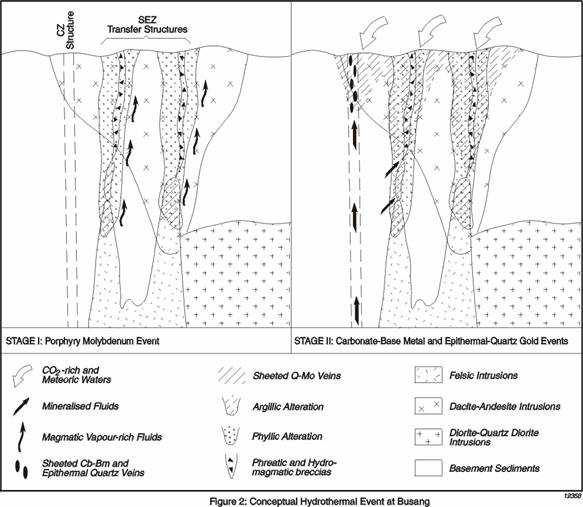
As the hydrothermal system continued to
wane, there was local deposition of epithermal quartz veins and associated
Au-As-Sb mineralisation onto the earlier formed vein systems.
Acknowledgements
The author would like to acknowledge that
the work was carried out, at least in part, at the request of, and the support
of John Felderhof. Mr. Felderhof
however, played no part in the preparation of this manuscript. The author would
also like to thank Dr. Ray Merchant for reviewing the manuscript.
References
Carten, R.B., White, W.H., and Stein, H.J., 1993,
High
grade granite-related molybdenum systems :
Classification and origin. in Kirkman,
R.V., Sinclair, W.D.,
Geological Association of
Corbett, G.J., and Leach, T.M., 1998,
Southwest
Structure, alteration and mineralisation. Special Publication Number 6, Society
of Economic Geologists, 236p.
Leach, T.M., 1999, Evolution of selected
porphyry
copper-gold systems in the Southwest Pacific region
and its relevance to exploration : Pacrim 99
Congress,
of Mining and Metallurgy, Proceedings, p. 211-225.
Sillitoe, R.H., 2000, Role of gold-rich porphyry models in
exploration, in S.G. Hagerman and P.H. Brown, eds., Gold in 2000,
Reviews in Economic Geology, v. 13, p. 311-346.
Van Leeuwen,
T.M., Leach, T.M., Hawke, M.M.
and
Hawke, A.A, 1990, The Kelian disseminated gold
deposit, East Kalimantan, Indonesia, in Hedenquist,
J.W., White, N.C. and Siddeley, N., eds., Epithermal
gold mineralisation of the Circum Pacific: Journal of Geochemical Exploration,
v. 35, p. 1-61.